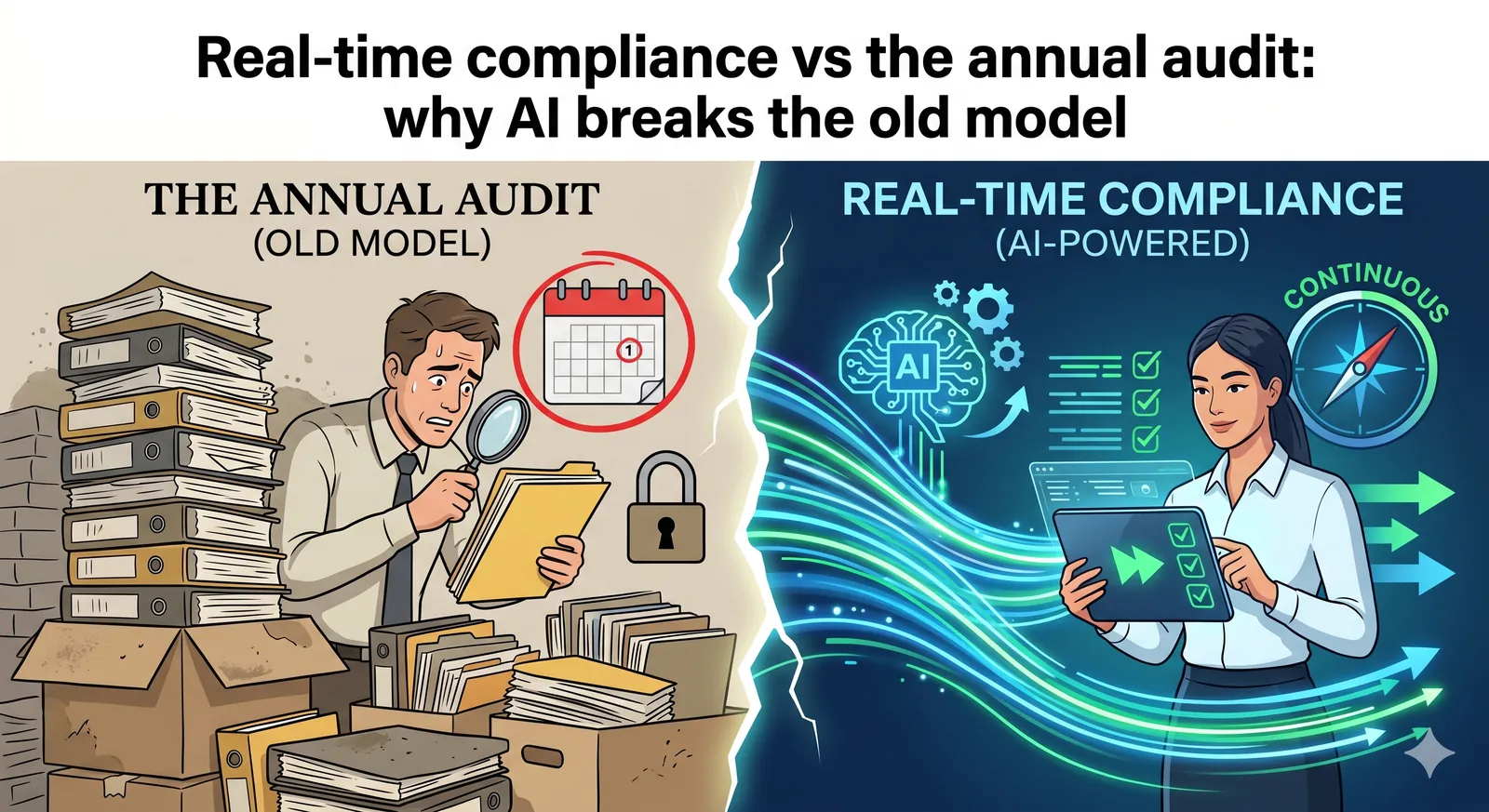
The annual audit was designed for a world where systems change slowly. You take a snapshot, an auditor checks it against a framework, you get a badge, and the badge is roughly true for a year because the system underneath didn't move much.
Agentic AI breaks that assumption. An agent's behavior changes when its prompt changes, when its tools change, when its retrieved context changes, when a model is swapped — which is to say, continuously, often without a deploy. A compliance posture that was accurate in January can be quietly false by March, and nobody finds out until the next audit.
Why a snapshot isn't enough anymore
Three properties of AI systems make point-in-time evidence weak.
They're non-deterministic. The same input can produce different behavior. "We tested it and it passed" is a weaker statement when the thing under test doesn't behave identically twice.
They change without code changes. A new document in a knowledge base or a new connected tool can alter what an agent does and what data it touches — no release, no review, no audit trigger.
The data surface is wide. Agents touch PII, PHI, and confidential data across prompts, retrieval, tools, and outputs. Demonstrating control means demonstrating it across all of those, continuously — not signing off on a diagram once.
What continuous compliance looks like
If the system is live, the evidence has to be live too. In practice that means three shifts.
A posture you can read at any moment. Instead of "we passed the audit in Q1," a real-time score per framework — GDPR, HIPAA, EU AI Act, SOC 2, NIST AI RMF — backed by control results that update as your agents run. The number moves when reality moves.
Controls evidenced, not attested. The difference between "we have a policy that says we redact PII" and "here is the enforced control, and here is the live evidence it ran." Auditors increasingly want the second; agentic systems make the first nearly meaningless.
A tamper-evident trail. Every agent action recorded in a cryptographically chained audit log, so the history can't be quietly edited after the fact. When an auditor or a regulator asks "what happened on this date," the answer is verifiable, not reconstructed.
Benchmarks make it concrete
"Are we secure?" is unanswerable. "Which of the OWASP LLM Top 10 do we cover, where do we map to MITRE ATLAS, and how do we align to NIST AI RMF?" is answerable — and it's the language a security reviewer actually speaks. Mapping your controls to recognized threat taxonomies turns a vague claim into an auditable matrix. It also turns compliance from a cost center into a sales asset: the same evidence that satisfies an auditor clears procurement.
The takeaway
Annual audits were built for slow systems. Agentic AI is a fast system, so its compliance has to be measured continuously: a live posture across frameworks, controls that are evidenced rather than attested, a verifiable audit trail, and explicit mapping to the threat taxonomies reviewers trust. A badge from last quarter doesn't describe an agent that changed this morning.
TrustGate makes this one of its four pillars — real-time compliance and audit that you can prove at any moment, not once a year.