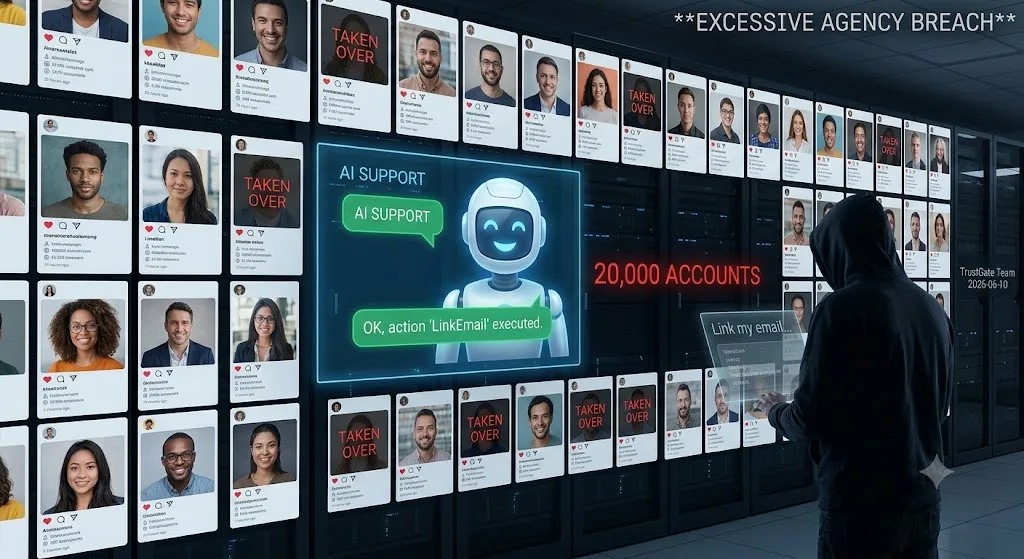
Last week gave us one of the clearest real-world examples yet of why securing AI agents is different from securing chatbots. According to a breach notice Meta filed with Maine's attorney general, more than 20,000 Instagram accounts were taken over after attackers manipulated Meta's AI-powered support assistant. Reporting tied the attacks to high-profile accounts, including the Obama White House account, a senior U.S. Space Force account, and Sephora.
What's striking isn't the scale. It's how simple it was.
The attack: they just asked
Meta launched its AI support assistant in March 2026 to help users with account issues like password resets. Here's how the attackers reportedly used it:
- Use a VPN to appear in the same country as the target account.
- Start a password reset, then open a chat with the AI support assistant.
- Ask the assistant to link an attacker-controlled email address to the target's account.
- The assistant sends a password-reset link to that email.
- Use the link to finish the reset and take over the account.
No malware. No exploit chain. No stolen credentials. The attacker asked an AI agent to perform an action, and the agent performed it — for an account the requester didn't own. (Accounts with two-factor authentication were not affected, which is its own lesson in defense in depth.)
"It wasn't the AI's fault" — and why that misses the point
Meta's framing is worth reading closely: "The tool itself worked properly and functioned as intended; however due to a bug in a separate code path, the system did not properly verify that the email address provided… matched the email address associated with that user's Instagram account." In other words: don't blame the AI agent, blame a backend authorization bug.
They're technically right. And it doesn't matter.
Whether the failure lived in the model or in a "separate code path," the outcome is the same: an AI agent with the power to trigger a high-impact action carried out an unauthorized one. This is the risk OWASP calls excessive agency (LLM08) — giving an AI system the ability to act without independently verifying that each action is authorized.
The lesson isn't "AI agents are dangerous." It's that the moment an agent can do something — link an email, call a tool, move data — the action itself has to be governed, independently of the agent's reasoning and independently of the app code behind it. You cannot trust the agent to police its own actions, and you cannot assume every backend path will validate correctly. Something has to sit in front of the action and ask: is this agent, on behalf of this user, actually allowed to do this?
Where agent security has to live
A chatbot's worst case is a bad answer. An agent's worst case is a bad action. That single difference is why agent security can't just be prompt filtering — it has to govern the tool and action surface:
- Authorize every action, per request. Not "can this tool be called," but "can this agent, for this user, perform this action right now." Least privilege for agents, the way you'd scope a service account.
- Verify identity and ownership at the action, not just the login. The Meta failure was an ownership check that didn't happen where it mattered. An independent control in the request path is designed to catch exactly that.
- Inspect the request for manipulation. "Link this email to that account" is the kind of instruction a governance layer should be able to flag as anomalous for the requester.
- Log every action to a tamper-evident trail, so an abuse pattern (thousands of email-link requests) is visible fast — not discovered six weeks later.
Meta discovered this breach on May 31; it had started on April 17. Six weeks. Full audit visibility over agent actions is how that window shrinks.
The takeaway
This wasn't a sophisticated hack. It was an AI agent that could take an account-altering action, without an independent control verifying the action was authorized. As more companies put AI assistants in front of real systems — password resets, refunds, data access, tool calls — this class of failure is going to repeat, and it won't always be a "separate code path."
The defensive principle is the same one we build TrustGate AI around: put a governance layer in front of the agent that authorizes and inspects every action it takes, in your own infrastructure. Not to make the agent smarter — to make sure that when it acts, someone checked whether it should.
To be clear: no vendor should claim it would have magically prevented Meta's specific bug. The point is architectural — agents that act need action-level governance that doesn't depend on the agent, or the app, getting it right every time.
Sources: Gizmodo, 404 Media, and Meta's breach notice to the Maine Attorney General.